
“Can I Kiss You?” Briefing for Military Installations addressing consent, bystander intervention, & supporting survivors of sexual assault

“Can I Kiss You?” Program for Campuses addressing sexual assault, consent, and bystander intervention

“Can I Kiss You?” Program for Middle Schools and High Schools addressing healthy dating, sexual assault, consent, and bystander intervention

“Like” page on FaceBook – now we are making waves

You have to love FaceBook for the medium it provides everyone. Today, we discovered someone started a “Like” page against asking for a kiss (specifically the phrase “Can I Kiss You?“).  In fact, this person actually is using the BUTTONS we provide here on our website for their image on their FaceBook “Like” page (yes OUR button with our saying and our website).

A PR expert once told me the day websites and people are mocking you – is the day you’ll know when your mission is effecting people on a mainstream level.  For us, we simply find it encouraging to know people’s beliefs are being so challenged that they  are creating online mediums to discuss it!

By the way, did you know we have a “Friend” page on our FaceBook Fan Page (click here).

Going Beyond What Is Expected

Student Leadership When Addressing Healthy Dating & Sexual Assault Awareness

RA’s, Orientation Leaders, Peer Educators, and many other student leaders have fantastic opportunities to lead, especially when they are around other students on their campus. The challenge is “How Far Will You Go” to make a difference? Are you willing to take on an issue — even when you are not “required” or “expected” to address the specific subject matter?

When the issue of sexual assault awareness arises among student leaders, most of the leaders share that they participate in the “standard” talk about parties, date rape drugs, locking doors to the residence halls, etc… However, very few student leaders take action toward creating a “healthy and respectful atmosphere” in their living quarters.

EXAMPLE:

A couple (Partner A and Partner B) is returning from a party at 11:30 PM. They are arriving at the living quarters of Partner A who lives in the residence hall. Partner A has been drinking, but is not belligerent or obnoxious (simply “tipsy”). Partner B appears to be sober. You observe the couple going towards Partner A’s room. Do you do anything?

Most students report that they would check-in on Partner A and make sure that everything is okay. If everything appears to be okay, the observing student will tell Partner A to be careful.

A few student leaders (very few) would do the following: Approach Partner A to see if the person has been drinking. Once established that Partner A has been drinking, the student leader would turn to Partner B and say, “Thank you for bringing Partner A back to the hall. We really appreciate it. We will take care of everything from here. Thanks again.” If Partner B gets upset or starts arguing, the student leader would say, “Look, Partner A has been drinking and it is our responsibility to make sure that our floor mate is okay and safe in this hall. We don’t want to get you into trouble or Partner A — so please let us take care of Partner A.” If Partner B becomes violent or threatening, the student leaders would call security and immediately have the person written up. If the student leader was not a RA, then the student leader would seek out the RA or the hall director to help intervene.

Some people ask “Why would you get involved in this situation?” In most states, you cannot give consent if you are not of sound mind (which drinking can certainly contribute to a person not being of “sound mind”). What are the odds that sexual contact will be taking place in the room of Partner A — once the couple goes into the room by themselves? The far majority of students state that the odds are tremendously high that sexual activity of some kind will take place in a room of a couple returning from a party, especially when one partner has been drinking and is tipsy.

What if the situation was different? If Partner B was talking violently or in a threatening manner toward Partner A, then would you interfere? Most student leaders answer, “Immediately.” If you had heard a rumor that Partner B had sexually assaulted another student on campus, then would you interfere? The majority of student leaders reply, “Of course.” What is the difference? A person who is acting “violently” or “mean” appears to be obvious. However, — if Partner B is not acting so obviously, people are more likely to ASSUME that Partner B is safe. A dangerous assumption.

The question becomes “How far will you go to help protect your fellow students?”

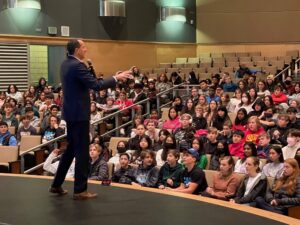
- written by Mike Domitrz, Executive Director of The Date Safe Project and Producer of HELP! My Teen Is Dating. Realistic Solutions to Tough Conversations. Each year, Mike speaks around the world in over 80 educational and military installations sharing the important messages of respect, consent, bystander intervention and supporting survivors.
To obtain permission to reprint any or all portions of this article, E-mail Mike here

Our Networks
Linkedinfollow me