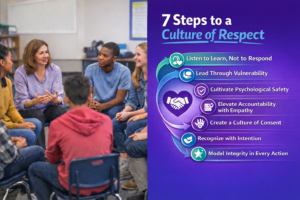


Parents talking with their sons and daughters about dating, intimacy, consent, intervening, and supporting survivors

Schools, Campuses, and Communities addressing healthy dating, consent, bystander intervention, and supporting survivors

Do Your Kids Ask? Parents Teaching Respect & Healthy Dating

Below are the 8 most common questions parents ask me when I am speaking in their schools or with their community organizations:

1. Without sounding like you are lecturing and without endorsing sexual activity, how do you approach the issue of healthy dating and intimacy with your child?
Kids are constantly told by their parents how “times were different” and “we were more respectful.” The truth is our culture has had a very unhealthy and confusing approach to dating, intimacy, and sexuality for a very long time – today is no different. Once parents admit the feelings of confusion they had as a young person and discuss their ‘scary’ or ‘troubling’ moments, the teenagers are more likely to connect with their parents. Sharing difficult and scary moments also helps your kids see the dangers and consequences of making bad decisions in a realistic and thought-provoking manner.

Instead of telling your child, “How times were different when you were young,” find a commonality between the two of you. When you tell someone how different it was back when you were young, why should your child think you can understand what they are going through? Connect with your son or daughter by opening the conversation with a question that shows you do understand their worries, concerns, and thoughts.

For example, a parent saying, “I remember getting all nervous before a date because I was wondering lots of stuff like, ‘Will my date like me?’, ‘Will my date find me attractive,’ ‘I wonder what my date is really like.’ Do you ever get nervous like that?” This type of question can make a parent more approachable to their child. No matter what your age is or the “times” you grew up in, these difficult feelings cross all generations. The key to success is asking in a sincere and caring tone.

2. What are the correct dating behaviors and practices to teach?
Self-respect, respect for your partner, and high standards need to be taught to males and females at all times. When a person believes in his or her self, the person is more likely to make the “right” decisions in difficult moments. Students with low self-esteem are more likely to lower their standards to please their partner — a very dangerous and unhealthy practice.

We need to teach young people to “expect to be respected” and to not tolerate any forms of disrespect (a date should ask before trying to do “something with you”). We need to teach how speaking out for yourself is both strong and sexy (many fear speaking out will be unattractive to their dates). We need teach them to better understand what “respecting” a date means. Respect is not simply opening doors, paying for meals, or other signs of chivalry. Respect is holding your date in the highest esteem and always getting your date’s permission before trying to do “something” with your date.

One of the most common mistakes parents make is assuming that the males are always the sexual aggressors. More and more, we are hearing about females becoming the more sexually assertive person in the relationship. Try to avoid all assumptions of gender roles.

3. At what age do my kids begin learning about intimacy?
By observing their parents, children learn intimacy at an extremely young age. If a young man sees his father ask his mother for a kiss, he is more likely to believe that asking is how he should act. If a young woman hears her mother talk about how respectful and loving her father is, the young woman is more likely to want a more respectful and loving partner.

Parents should begin discussing appropriate touching at early school ages and then advance into issues of intimacy as those years approach. Due to the images and discussions the television and the entertainment industry promote to younger audiences, parents need to have these conversations at much younger ages (for many, prior to the age of 10 is appropriate — kids are seeing or hearing about much more explicit behavior by this age). Even if you do not let your children watch such programs, they are likely to hear about these shows from their peers.

There is no one magical age for these conversations to take place. Each set of parents must decide what is right for his or her child. However, the day your child is born is the day your child begins watching you. Make a conscience effort to display respect in all aspects of intimacy and sexuality by asking before kissing people. When your kids watch you, what will they learn?

4. What do I teach my kids about the “Age Laws?”
Parents must teach their child about age laws. Each state has very specific laws regarding minors involved with sexual activity. Two 15 year olds could give each say, “Yes” to engage in certain sexual activity with each other and they would still be breaking the law in many states. In addition, parents need to help young people understand that these laws exist to help “protect” them. Learn the laws in your state so that you can address the legal aspect – just don’t make the legal element your focus. Kids typically find such conversations to be boring and most kids don’t fear the authorities catching them engaged in sexual acts.

5. How can parents help their kids avoid peer pressure?
Immediately begin treating your child with respect and with great value. By teaching a child how “special” he or she is, you can help him or her understand “why” getting involved with intimacy should be saved for an extremely “special” moment. Research proves that the earlier a child gets involved in intimacy is directly related how much “value” the child places in his or her own self. For this reason, we need to connect with our children in an engaging and “open” approach.

Children fear being lectured and being judged. Children love to be “heard.” Ask questions, listen with an open mind, and then have positive discussions. When your child feels a special connection with you and understands “why” you have such strong beliefs, he or she is more likely to believe YOU over his or her friends. Plus, when a child understands the “why” to not getting involved with certain behavior, he or she will have a real reason for saying “no” to peer pressure (instead of simply saying “because my parents said so”). The child will WANT to say “no” because he or she will believe that “no” is the right answer!

6. My son is very respectful — why would I need to worry about him sexually assaulting someone?
Most “respectful” males still learn about aspects of intimacy through their friends and what they see portrayed on television and in the movies. These sources of education promote disrespectful behavior by teaching males that if they are “smooth,” they can just make their moves and their partner will want them. When males just “make their moves,” they take a tremendous risk of engaging in behavior that their partners do not want – thus leading to committing a sexual assault. Parents need to talk with their sons about truly respecting a partner by understanding how valuable and special each person is as a human being (including the body, the mind, sexuality, personality, and values). Sons need to learn that the only way you can be sure what your date wants is to “ask” your date first.

7. My daughter is tough and outspoken — I don’t have anything to worry about, right?
WRONG! Many tough and outspoken females have been sexually assaulted or have become unexpectedly pregnant. A “tough” and “outspoken” female might think she is invincible and that belief can be extremely dangerous (she may believe “she would never get pregnant” or that “no man could ever sexually assault me”). By being over-confident, she may be less likely to see potential signs of trouble. Another female may be very confident in most aspects of her life, but not with intimacy or relationships.

Parents need to teach their daughters “awareness” to better equip their daughters for noticing signs of trouble. At the same time, we must understand that there is no 100% form of sexual assault prevention that a victim or survivor can utilize (100% prevention can only result by the assailant not attempting the behavior). A young woman or man could follow every healthy dating advice ever given and still be sexually assaulted. Stress to your daughter that she cannot ever be at fault for someone sexually assaulting her – this point must be stressed. Many, many females never tell their parents about their assault because the daughter fears how their parents will react. Help your daughter know that you will be there to support her and love her at all times!

8. Do I really need to have these conversations?
Not talking about complex issues simply leads to confusion. When kids talk to their friends, every component is often exaggerated and glamorized (every romantic encounter is amazing and romantic in their “dream world”). Thus, building the young person’s drive to experiment with sex, drugs, and other dangerous behaviors. Help the child learn the truth by speaking honestly about your memories in a manner that they can relate to. If you can be a little humorous, you can help break the barriers down for your teenager to start talking openly to you.”

- written by Mike Domitrz, Executive Director of The Date Safe Project and Producer of HELP! My Teen Is Dating. Realistic Solutions to Tough Conversations. Each year, Mike speaks around the world in over 80 educational and military installations sharing the important messages of respect, consent, bystander intervention and supporting survivors.
To obtain permission to reprint any or all portions of this article, E-mail Mike here

Continuing the message long after the program!

Are you aware of the IMPACT the “Can I Kiss You?” show will have in your community weeks and even months AFTER the presentation?  The program is designed with short-term and long-term planning to insure significant change for years to follow.  Toward the bottom of this page, you will read one example of a community (especially student leaders) taking powerful steps for their current and FUTURE school year.

How does the “Can I Kiss You?” program overcome the pitfall of other educational lectures which only stimulate excitement for a day or two?   Here at The Date Safe Project Inc, we provide ample resources and materials for each school system to continue the lessons learned in every presentation! The “Do You Ask?” poster series is the most direct consent based educational poster series used throughout the world. Each poster is both eye-catching and educational. The “Do You Ask?” theme of this innovative poster campaign teaches students “The only way you can absolutely know what your partner wants is by asking first!” When you bring Mike to speak, be sure to ask Rita about purchasing some of these great posters for your school and community.  You can see all the posters at: www.DoYouAsk.org
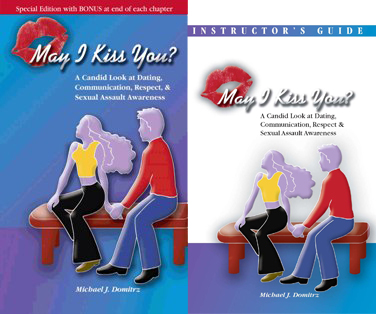
May I Kiss You? written by Mike DomitrzVoices of CourageIn addition to the powerful line of posters, you can utilize both of Mike Domitrz’s books, May I Kiss You? and Voices of Courage, to continue the lessons and skills shared throughout the day with Mike on your campus. Get the books for a discounted bulk price in the 100 PACK special package. With the 100 PACK, you choose 100 books (any combination of the 2 books you want) and you get each book for only $8 (over 50% discount). Plus, Mike will be happy to sign each book for you and your students. Click here to get the 100 PACK now!

Next, start a “Pledge for Action” campaign in your schools and community.  Learn more at www.PledgeForAction.org.

Plus, use the online forums here on the website to discover ideas with others and to share your own successes and lessons learned from your community and school efforts!

READ THIS POWERFUL EXAMPLE FROM THREE COMMUNITIES

Below is one letter from a sexual assault crisis center sharing a great example of how students put the lessons from the program and from Mike Domitrz into action in their schools, towns, and cities:

Through a community education grant, Hope House of South Central Wisconsin was able to co-sponsor Mike Domitrz’s “Can I Kiss You?” program at three of our local high schools in Columbia County. We had wanted to bring Mike to our area for some time and were thrilled when we had the opportunity to do so. Mike did a fantastic job connecting with all of the students and using humor to demonstrate his simple yet vital messages about respect and consent. One principal told us that she felt it had a great impact and that they have never had an assembly where so many students and teachers were talking about it. She even received a call from a parent saying thank you for bringing Mike to speak because her sons came home that night and initiated a conversation about respecting women!

Although Mike’s presentations were towards the end of the school year, we diligently worked with the schools’ staff to build on the momentum Mike’s appearance had created. Hope House utilized the opportunity to talk about Mike’s program during the presentations that we normally give to the Health, Family Living, and Social Studies classes. At all three high schools, we worked with staff to find students that were interested in creating posters that would help reiterate Mike’s messages. Students created posters with messages (in English and Spanish), such as “Did you ask?”, “Respect the Answer”, “Respect Yourself”, “Respect Your Partner”, “Have you opened a door?”, “Ask Before You Act”, and “Be a Friend”. These posters, along with Mike’s Date Safe Project posters, have been put up in the schools for the last couple weeks of class – a great reminder for students as they start their summer vacations. In addition to creating posters, the students signed their names on a large white sheet of paper that had Mike’s Pledge of Action attached to it. The names on the list are adding up every day as the student bodies now have the opportunity to sign.

One of the high school’s Student Council organized an Awareness Day as a result of Mike’s presentations. Hope House gave them extra “Can I Kiss You?” tattoos to wear during the event. They created a display of Mike’s books, May I Kiss You? and Voices of Courage, along with other school library books related to sexual and dating violence, and Hope House helpline cards and brochures. They created and distributed pins for students made of teal and purple ribbon to raise awareness about sexual assault and domestic violence. They also had the large sheet of paper with the Pledge of Action available for students to sign.

Hope House is continuing to meet with school staff to see if there are additional activities that we can do with students over the summer and next year, such as putting their posters up in popular summer hang-out spots, working with students during a summer leadership program, publishing an article for parents in the schools’ fall newsletter, and creating social norms posters related to the student assembly pre- and post-test survey results. All of these opportunities and exciting momentum would not have happened without Mike’s programs.

Jess Ritschke, Community Education Coordinator,
Hope House of South Central Wisconsin

CALL 800-329-9390 TODAY.
Ask about the NEW INSTRUCTOR’s GUIDE

Click here to send us an e-mail.

Watch School Assembly with over 600 Students at 8am!

In this video, you are watching over 600 students at 8am in a School Assembly of the “Can I Kiss You? program engaged, thinking, opening their minds, and making decisions to change their actions.

Bring the “Can I Kiss You?” program to your community and witness your students talking nonstop about the positive changes they WANT to make. You’ll hear them saying how much the presentation “blew their mind” and “really has me thinking about how I need to change the way I date.

SPECIAL OFFER: By calling 800-329-9390 today, you will receive a complimentary copy of the critically-acclaimed book “May I Kiss You?” by Mike Domitrz.  Schools throughout the country use this book as curriculum in the classroom and for creating positive change with their students.  Click here to send us an email.

INSURING A GREAT ASSEMBLY FOR YOUR SCHOOL:

One of the biggest fears many middle schools and high schools have is “How can we know this speaker is going to capture our students attention AND do so appropriately while giving them needed tools for making a difference?”  The answer is:  You need an expert with a proven track record of excellence with schools of all sizes, demographics, and cultures.  You require a quick thinking professional who is gifted at reacting specifically to your students’ reactions and comments.

Your presentation to the two junior highs: 500 and 440 teens, were outstanding.  These teens were rowdy audiences, but you handled them expertly, got and held their attention and really made an impact.  Even the School Principals who are somewhat conservative were very impressed.
Anne Smith, RN, BSN, Yuma County Public Health Services District (AZ)

1500 students at NW Missouri State University captivated

For over 2 decades, Mike Domitrz has been inspiring students, educators and parents with the unique combination of his hilarious sense of humor along with his uncanny ability to draw hard-hitting emotion from audiences.  School districts constantly share what a lasting impact he has with people of all ages.

It has been 3 months since you presented your ‘Can I Kiss You?‘ Program to high school students, and separately to parents, in our communities of Lake Forest and Lake Bluff, Illinois.  To my surprise, and immense satisifaction, people are still talking about it!

…three students at a local coffee shop were overheard recently, two full months after your visit, discussing the idea of ‘asking’ that had been presented by ‘that dude we heard at school in the Fall.
Lydia Backer, Program Director, LEAD (IL)

With Mike, you get a critically-acclaimed author and passionate educator on healthy dating, consent, bystander intervention, and supporting survivors who is leading the way by constantly changing and further improving each presentation he gives.  You get a professional presenter who studies exactly how each audience member reacts to different techniques and learning styles.  You get a dedicated advocate who commits to always respecting every aspect of a very sensitive topic.

Mike Domitrz brought his powerful presentation to Mahnomen, Wauban and Circle of Life Schoos on the White Earth Ojibwe Nation and to an Alternative Learning Center near the reservation reaching 870 students…His method of not putting words into their mouths but instead using their words and language was absolutely incredible

It is important to recognize that never before has there been a National Speaker who has ever promised our youth that he would respond to their emails within 24 hours. His commitment to make effective changes in the lives of our youth is to be commended.”
Lisa Brunner, Executive Director, Community Resource Alliance Tribal Alliance (MN)

To be an effective and powerful educator, you need to always be learning new approaches and concepts of working with people of all ages (students, staff, and parents).  Yes, the educator needs to be a STUDENT.  The #1 source for teaching better speaking techniques and presentation skills is the National Speakers Association (NSA) – the professional trade organization for speakers around the world.

Certified Speaking Professional with the National Speakers AssociationMike Domitrz is an active and involved member of NSA.  In fact, he is one of the few Certified Speaker Professionals (CSP) across the globe specifically working in Education.  Each year, the National Speakers Association gives this earned recognition to those speakers who accomplish all of the following criteria:

  • At least 50 speaking events each year for 5 consecutive years.
  • A score of at least 7.5 on evaluations from clients over the past 5 years (on a 10 point scale).
  • Minimum level of professional credits earned by attending NSA Educational Events (shows commitment to the craft of working with audiences and making a difference).

What does Mike being a Certified Speaking Professional mean to you?  You are getting a leading authority, author and ally who is also one of the top speaking professionals in the world.

Mike understands not only his message but the interests and needs of the audiences he serves. He has a very energetic and entertaining style that engages all audiences. His message is powerful and the people in his audience naturally gravitate to him.”  Sam Silverstein, former President of the National Speakers Association.

Best of all, you are working with a devoted professional who CARES about you, your organization, your community, and each person in the audience.  Individuals and organizations who have brought Mike to speak are continually telling us here at The Date Safe Project how wonderful he is to bring to their schools.

He made my job very easy. He answered my numerous inquiries promptly, respected and honored our requests regarding his presentations and took the time to get know our audience before he arrived.”
Jayne Giroux, Making Good Choices Council, Bradenton (FL)

SCHEDULING MIKE TO SPEAK. Due the long lasting impact Mike’s program has on communities, his available dates tend to quickly be taken each year.  How can you insure a date is held for you?

Call Rita in our offices at 800-329-9390 TODAY!

**You can click here to send us an email.

SPECIAL OFFER: By calling 800-329-9390 today, you will receive a complimentary copy of the critically-acclaimed book “May I Kiss You?” by Mike Domitrz.  Schools throughout the country use this book as curriculum in the classroom and for creating positive change with their students.

Abstinence & Consent – Do They Belong Together?

How discussing consent is the ultimate way to discuss abstinence.

Throughout the country, some parents and educators are saying, “Our schools believe in discussing abstinence. Won’t teaching teenagers about consent lead to more sexual activity among those same teenagers?” Teaching consent stresses establishing personal standards, respecting boundaries, and always understanding the importance of having a choice.

Unequivocally, students participating in the “Can I Kiss You?” programs say “asking first” will greatly reduce the amount of sexual activity among their age group (thus increasing the level of students practicing abstinence). Teenagers share the following four main reasons for why education on consent decreases sexual activity among their peers:

1) Teenagers are not typically comfortable enough with their partner (date or a hook-up at a party) to ask first. Having to ask would become uncomfortable in those situations and so the person would not make any advancement for potential sexual activity.

2) If teenagers were being asked and were not sure of what they actually wanted, they would be given a choice to say, “No” without any negative consequences or without guilt or pressure being applied to them. In a healthy situation of “asking first,” you never pressure someone or question them about their choice to say, “No.” You always honor the choice you gave your partner by “asking first.”

3) You cannot give consent when you are drunk. A great deal of intimacy occurs under the influence of alcohol and other drugs. Thus, these occurrences would be greatly reduced if consent was required before engaging in intimacy.

4) When students have learned about consent, they are more likely to feel comfortable telling their partner that he/she must ask first. In doing so, the person is sending a strong signal of healthy expectations and boundaries. By learning consent, the person who is having “moves made” on him or her is more likely to stop and talk with a partner before getting into any intimate situations.

Teaching consent is much more than simply “how to say ‘No’ to your partner.” Discussing consent means teaching communication skills, respect (what it means to each person), boundaries, personal values, and much more. In addition, discussing consent involves sharing what happens when someone does not get consent and how to support a survivor of sexual assault.

Many schools (including religious, abstinence-based education, and comprehensive sex education programs) want their students to have a discussion that respects abstinence while still preparing students for healthy intimacy down the road. After all, discussing consent is the ultimate way to discuss abstinence. If partners asked first, a teenager’s desire to be abstinent would always be respected AND honored.

- written by Mike Domitrz, Executive Director of The Date Safe Project and Producer of HELP! My Teen Is Dating. Realistic Solutions to Tough Conversations. Each year, Mike speaks around the world in over 80 educational and military installations sharing the important messages of respect, consent, bystander intervention and supporting survivors.
To obtain permission to reprint any or all portions of this article, E-mail Mike here

Parents and Teens, Let’s Talk About Sex

What is the message parents are giving their children when it comes to sex education?   For the most part, is seems to be nervousness.  You can read examples in the following article:

Kids continually tell stories about how awkward their parents acted when giving them “the talk”.  Is that the message parents should be sending; that sex and talking about sex is awkward and let’s get the conversation over with as soon as possible? 

Parents need tools to help them talk.  Here is a neat approach:  Our bodies are the only thing we truly can call our own.  As the owner, you decide how it’s treated, who touches it, what we feed it, and how we take care of it. 

This is the message we should be sending our children when it comes to sex and teen violence.  Discuss the emotions involved with sex.  Talk about what love is; respect, open communication, consent, boundaries and what love isn’t; manipulation, intimidation, jealousy, control, violence.   

Remember, your child is your biggest mirror.  The attitudes and behavior regarding sex or any aspect of your life will mimic itself in your child.  Check your attitudes and behaviors and readjust if necessary.

Jamie Lynn Spears, Pregnancy, Statutory Rape, and the How Schools Need to Talk with Students

Jamie Lynn Spears’ official announcement she is pregnant is bringing up conversations about the legal age of consent for sexual activity.  From the Genarlow Wilson case in Georgia earlier this year to now the pregnancy of 16 year old Jamie Lynn Spears (the star of Nickelodeon’s "Zoey 101" and sister of Britney Spears), our country needs to take a sincere look at consent and society’s current approach to sexual education in our schools and in our homes.  From educators to parents, direct conversations are needed with all students. 
The entire concept of "consent" is constantly misunderstood.  In reporting of pregnancies involving minors, the media often says "consensual sex among minors."  When a state has laws stating a minor cannot give consent with a partner of a specific age, the media needs to use the following wording instead, "mutually agreed upon sex." The failure to use the correct wording leads to students and overall society responding with, "How can consensual sex be rape?"  Consent is a LEGAL term.

Here is where the problem begins.  How many teenagers and young adults actually have MUTUALLY AGREED UPON sexual activity?  For the sexual activity to be "Mutually Agreed Upon," it would demand two people agreeing together – A CONVERSATION (No, not a contract.  Two people talking with each other).  However, we know most students do not openly discuss their sexual activity with their partner until they are already at the point of being uncomfortable OR until after the act has already been done OR or not at all.

While speaking in middle schools, high schools, and colleges, students continually tell me that if they TALKED FIRST, it would slow down the speed at which the sexual activity is taking place AND often stop it from happening at all.  By talking first, they would frequently find the conversation uncomfortable which would be a telling sign one of the two people (if not both) is not mature enough and/or comfortable enough in the sexual situation that is about to occur!  Teaching consent the correct way better protects today’s students.

Start this discussion in your classroom and then report the results in the "Comments" section of this post.

Our Networks
Linkedinfollow me