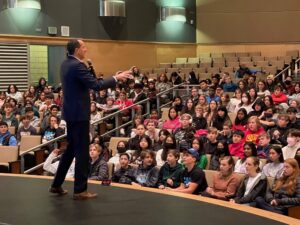

Speaking on Air Force Base is an Honor and a Rush!

This past Monday, I spoke to many of the men and women at Offutt Air Force Base in Nebraska.  From the leaders of the base to the newest of the enlisted, everyone was wonderful to work with.  Often non-military people will ask me the following two questions about speaking to the military, "Who brings you to a base and what is it like?"

Offutt_afb In the military, SARC stands for "Sexual Assault Response Coordinator" and is a position designated to address the many issues surrounding sexual assault.  When I have been brought onto a military base, it has always been by the SARC contact (or someone from that office).  These professionals are passionate individuals who fully understand the need for this content to be given for all levels of the military.  Due to timing and other restrictions, we are not able to talk with every single person and so each base must choose which of their members will attend.

As to the "What is it like speaking to the military" question people love to ask me, the answer is simple — it is FANTASTIC!!  Why wouldn’t it be?  Typically, the audience is 18 – 24 years old (almost exactly the same as a college audience).  They are in the "dating world" or married.  Consequenlty, they see and/or experience all the problems and struggles that exist in relationships and intimacy.  Plus, they enter the program with a positive attitude of wanting to be entertained and challenged — all while displaying respect for you as a presenter.  The e-mails and comments we receive from the attendees afterwards prove how attentive of an audience they are AND how much they wanted the material.

Every time I get to speak to our military, I am honored!!  As I told the men and women on Monday, "My work depends on me being able to speak freely and being able to challenge society’s norms.  I am forever grateful for your willingness to fight for those freedoms!!!"

Do you really want my opinion? Do you take it in or simply let it be said?

When someone provides you feedback, how do you absorb their words?  Do you open your mind with a positive energy of "How can I make that work?" or do you respond with "I like your ideas, BUT . . ." and immediately share why you cannot or will not utilize their idea(s)?

Recently, I was sharing on a college e-mail listserve how schools can utilize our "Pledge for Action" during Sexual Assault Awareness Month in April.  At the time, the pledge was called the "Pledge to Protect."  We have been utilizing this pledge for over a 1.5 years.  Through this e-mail exchange on the listserve, one of the members shared how she did not like the word "Protect" in the pledge’s title because of the Patriarchal meanings and connotations of that specific word.  No one was questioning the content of the pledge — just the name.

We had a choice.  We could say to ourselves, "It is one person and this pledge has been extremely effective.  If we make this change, we would have to get new websites, change all the current information we send out, and make lots of other updates."  The other option we had was to ask the entire listserve, "What if we change the name to ‘Pledge for Action’ which requires signers to commit to taking real action?  What do you all think of this idea?"

We chose to open this question to the entire listserve and the feedback was OVERWHELMING — we kept hearing "WE LOVE THE CHANGE to Pledge for Action!!" (www.pledge4action.org).

From that change, another colleague of mine suggested, "Mike, with this new name, I can envision a pin people can wear year-round that says, ‘Pledge for Action’ and it would be a die-cast pin (like a National Honor Society pin in high school) so it would be sharp looking."  The "Pledge for Action" pins have now been ordered.  We have a pin designed in the shape of the logo used on the pledge with the wording "Pledge for Action" across the front.  Plus, we have a new t-shirt coming out which is designed specifically for the pledge!

All of this change happened because one person shared their opinion with us.  If we had discarded their e-mail, we would have lost out on improving an already successful educational campaign.  The new changes are going to help us get this campaign out to many more populations, especially with schools, communities, and organizations being able to use the pins and the shirts in conjunction with the signing of the pledge.

The surprising part of this experience were the amount of e-mails saying, "Thanks, Mike, for being willing to listen to change.  Most people would not have opened up this conversation about their own work."  To me, it seems like the only choice.  How can you ask students and communities to open their minds — while you keep yours closed to helpful feedback?

Who will you ask for their ideas today?  What positive changes will you make?  Join us in our newest change and sign the pledge at www.pledge4action.org.

Our Networks
Linkedinfollow me